Liberius Mikulitsyn and Vdovichenko’s rivalry
Doctor ZhivagoThe rivalry between Liberius Mikulitsyn and Vdovichenko turns political disagreement into a contest over who may hold influence in the partisan camp. Vdovichenko argues that civic institutions must grow from below, like seedlings taking root, yet the movement’s command structure answers his dissent with execution. His death leaves Svirid shocked and feeling trapped, and makes the conflict a concentrated example of revolutionary authority suppressing the pluralism it claims to serve.
A Rivalry Within the Partisan Command
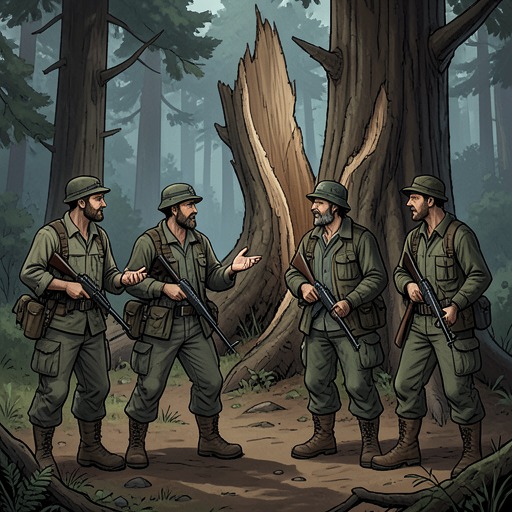
Vdovichenko appears at a political meeting as an influential partisan with standing enough to challenge the speaker openly. He sits beneath the speaker’s very nose, interrupting rudely and disrespectfully; despite being little more than a boy, he is identified as a leader whose men obey and venerate him. His authority is visible not only in his interruptions but in the silent, unwavering loyalty of two bodyguards standing beside him. The scene establishes a rivalry rooted in competing power within the movement, rather than a simple disagreement between an officer and a subordinate.
The contest is also ideological. Vdovichenko says he agrees with the majority and argues that democratic civic institutions should be founded from below, taking root like seedlings, rather than hammered into place from above like fence posts. He invokes the Jacobin dictatorship and the Convention’s defeat by the Thermidorians as a warning against imposed authority. His agrarian image presents political legitimacy as something that must grow through collective participation, in direct contrast to command imposed by force.
Dissent and the Logic of Irreversibility
The debate around Vdovichenko’s position is already narrowing. Some participants distrust military specialists because of the possibility of counterrevolutionary elements; others demand a resolution and say it is late. Svirid supports Vdovichenko’s insistence on bottom-up institutions, but also argues that the movement has gone too far to turn back: having entered the water, they must continue. At dawn the meeting breaks up, its discussion increasingly confused, and those present leave one by one, taking precautions. The scene makes the rivalry part of a larger impasse: participants can recognize the danger of imposed power while feeling unable to withdraw from the course of events.
The later account identifies the underlying political grievance directly. Vdovichenko’s crime, in Svirid’s view, was that his influence rivalled Liberius’s and caused dissension in the camp. The description makes rivalry itself—independent influence within the same movement—the basis on which dissent becomes punishable. The struggle is therefore not merely over policy: it concerns whether a leader’s authority may be challenged by another figure with a following of his own.
Execution and the Suppression of Opposition
Vdovichenko is among the eleven ringleaders of a conspiracy sentenced to death; two male nurses condemned for brewing vodka are also executed at the same place. The account sets the punishment on a forest platform edged with upright granite boulders, a location that had seemed to Yurii Andreievich Zhivago like a possible ancient shrine. The contrast between that imagined site of worship and its use for a modern political execution gives the scene a grim historical resonance without changing the immediate fact: the partisan command settles an internal conflict by killing those it has condemned.
At the edge of the grave, Vdovichenko remains defiant. He addresses Rzhanitsky as one anarchist to another, warns that the new executioners will not understand their protest, and declares that history will tell the truth. He presents the condemned as martyrs for their ideals and invokes a revolution of the spirit and world anarchy. His final speech does not stop the execution; it preserves his disagreement as a public challenge to the authority that is about to silence him. A volley kills most of the condemned, and a second finishes the rest.
Consequences and Political Meaning
Svirid is deeply shocked by Vdovichenko’s shooting. He wants to leave the partisans and return to his former independent life, but believes he cannot do so: desertion would bring execution. The rivalry thus has consequences beyond the death of its most prominent challenger. It deepens the fear within the camp and makes continued membership feel compulsory even to someone who wishes to withdraw.
The episode exposes the contradiction between Vdovichenko’s language of institutions growing from below and the command’s treatment of competing influence. His democratic argument is answered not by persuasion or a settled public process, but by the elimination of dissenters. The rivalry’s significance lies in this reversal: a movement speaking in the name of collective liberation reproduces coercive authority internally, while the condemned man’s appeal to posterity becomes the only surviving counterclaim to the command’s verdict.